Category: Branding & Design

  • The Ultimate Website Redesign Guide: How to Revamp Your Site Without Losing Customers

    The Ultimate Website Redesign Guide: How to Revamp Your Site Without Losing Customers

    Imagine walking into your favorite local grocery store. You know exactly where the milk is, the staff is friendly, and checkout is a breeze.

    Now imagine walking in the next day to find the store completely changed. The aisles are rearranged, the lights are dim, the sign on the door is gone, and the milk is hidden behind a wall of brooms. You would probably get frustrated, leave empty-handed, and head straight to the competitor down the street.

    This is exactly what happens when a business executes a sloppy website overhaul.

    Your website is your digital storefront. When done right, a fresh look can skyrocket your sales and make your brand look incredible. When done wrong, it can confuse your loyal customers, tank your search rankings, and permanently damage your bottom line.
    Mismanaging your site overhaul can tank your organic traffic by up to 50% and alienate loyal customers overnight. Below is the precise strategy for executing a flawless, revenue-driven revamp.

    Whether you are a small business owner, a marketing student, or a professional designer, this guide will show you how to pull off a flawless website makeover.


    What is a Website Redesign?

    A website redesign is the process of significantly changing your site’s visual appearance, code, navigation structure, and user experience.

    However, do not confuse a total redesign with a simple aesthetic refresh. A true redesign re-engineers how your site functions to drive business growth actively.

    How do you know it is time for a full overhaul? Here are a few telltale signs that your current system is failing you:

    1. Mobile Friction is Costing You Conversions

    More than half of all internet traffic comes from mobile devices. If users have to pinch their screens, zoom in, or struggle to tap tiny buttons just to read your text, you are bleeding revenue every single day.

    2. Your Bounce Rate is Sky-High

    If people open your website and immediately click the “back” button, something is broken. A high bounce rate usually means your site is confusing, visually outdated, or takes too long to load.

    3. Your Business Goals Have Outgrown Your Platform

    Maybe your site was built years ago as a simple blog, but now you want to sell products online. If your current platform cannot support your transaction volume, it is time to transition to high-performance web design & development services to scale properly.
    Is your site currently turning prospective users away? Before changing a single line of code, get a benchmark report.
    Claim Your Free UX & SEO Audit to Uncover Hidden Drop-Off Points

    The Secret Ingredient: Focus on the User Experience (UX)

    The single biggest mistake businesses make during a redesign is focusing exclusively on cosmetics. They demand flashy animations, massive video backgrounds, and complex, artsy layouts.

    But a website is a revenue tool, not a painting. If your visitors cannot locate your contact page or checkout button within 3 seconds, they will leave.

    The 3-Second Rule

    When a user lands on your homepage, they must immediately digest three core pieces of information:

    • What do you do or sell?

    • How does it make their life better?

    • What exact action do they need to take next (e.g., buying a product or booking a call)?

    If your new design buries this information under a mountain of heavy, fancy graphics, your conversion rates will tank.

    The 5-Step Roadmap to Redesign Your Site Without Losing Traffic

    Ready to build a better site? Follow this step-by-step framework to keep your project on track, under budget, and structurally primed to convert.

    Step 1: Benchmark Your Current Metrics

    Before you break anything, you need to know what is currently working. Open your analytics dashboard and document your current monthly visitors, baseline conversion rates, and your highest-performing pages. This gives you a clear data baseline to measure your success post-launch.

    Step 2: Protect Your SEO (Search Engine Optimization)

    This is where most businesses ruin their hard work. If you change the web addresses (URLs) of your pages without telling Google, you will lose your search rankings overnight.

    • Create a URL Map: Document every single old URL on your live site.

    • Set Up 301 Redirects: This explicitly tells search engines that your old page has permanently moved to a new home, preserving your authority. If you are handling complex migrations, integrating professional SEO & digital marketing oversight is mandatory to prevent traffic drops.

    Step 3: Gather Content Before Designing

    Do not design a beautiful layout and then try to awkwardly cram your copy into it. Write your words first. Figure out what messages, value propositions, and headlines you need. Then, design a tailored layout that naturally highlights those words.

    Step 4: Keep Your Branding Consistent

    Your website should feel like an extension of your physical brand. Use the same logo, primary color palettes, and brand voice that you use across your social media and physical packaging. Consistency builds immediate consumer trust, which is why investing in cohesive branding & creative design pays massive long-term dividends.

    Step 5: Test Everything Before Going Live

    Do not just launch the site and hope for the best. Review your staging site on iPhones, Androids, Macs, and PCs. Test every single form field, click every button, and process a test transaction to ensure your custom eCommerce solutions function flawlessly.

    Real-World Examples of Redesign Success and Failure

    Let us look at how design choices directly impact a business’s revenue.

    The Redesign Disaster: Target (2011)

    Years ago, retail giant Target rolled out a massive redesign of its online store. They focused heavily on beautiful, artsy imagery. However, they broke the checkout process, causing the site to crash repeatedly on big shopping days. Customers were furious, and the company lost millions in potential holiday sales because it prioritized looks over function.

    The Redesign Win: A Local Landscaping Company

    Let us look at a smaller, more practical example. A local lawn care business had an old website built in 2015. It featured text-heavy pages and a complicated contact form.

    During their redesign, they simplified the menu, added a bright green button that said “Get a Free Quote in 60 Seconds,” and uploaded real photos of their actual team. Even though their web traffic stayed the same, their incoming phone calls and leads tripled simply because the site removed friction.

    Don’t Guess Your Redesign Strategy

    Let our senior technical architects map out your migration plan so you don’t lose a single keyword ranking.

    Get My Free Migration & UX Blueprint

    Quick Actionable Tips for Your Website Makeover

    • Speed It Up: Compress your large images before uploading them. Slow websites drive customers straight to your competitors.

    • Use Strategic Whitespace: Do not crowd your pages. Leaving blank space around text and images makes your content clean and easy to scan.

    • Make Text Highly Readable: Use high-contrast colors (like black text on a clean white background) and a font size of at least

    Frequently Asked Questions (FAQs)

    1. How much does a website redesign cost?

    The price varies wildly based on complexity. A freelancer or small agency might charge anywhere from $2,000 to $10,000 for a standard business site. Custom enterprise platforms requiring specialized integrations will scale higher based on your functional needs.

    2. How often should a business redesign its website?

    On average, companies update their websites every 2 to 3 years. Technology changes quickly, design trends evolve, and your business goals will grow. For businesses without an in-house team, enrolling in a dedicated website maintenance & support program ensures long-term performance.

    3. Will a redesign hurt my Google rankings?

    It can cause a temporary dip for a few weeks as Google crawls the new page structures. However, if you use proper 301 redirects, optimize your Core Web Vitals, and provide better content, your rankings will ultimately go up.

    Conclusion: Build with Purpose

    A great website redesign is not about chasing the latest tech trends or picking the prettiest colors. It is about removing the friction between your customer and your product. By keeping your layout simple, prioritizing mobile users, and protecting your SEO, you can turn your website into a powerful sales machine.
    Tell Us About Your Next Step
  • Why Branding and Creative Design Matters in Business

    Why Branding and Creative Design Matters in Business

    In today’s world, there are thousands of businesses competing online. So how do people decide who to trust and who to buy from? Most of the time, the answer is branding and creative design. The way your business looks and feels tells people a lot about you even before they read a single word. This article will explain why branding and creative design are so important for any business, and how you can use them to grow.

    Does your current brand identity look as professional as the services you deliver? Stop losing premium leads to competitors with better graphics. Let us build an authoritative, cohesive visual asset that stands out. Claim Your Free Brand Identity & Creative Audit Today

    What Is Branding and Creative Design?

    Branding: This is your business identity. It includes your name, your values, the way you talk to customers, and the promise you make to them.

    Creative design: This is how your brand looks. It includes your logo, colors, fonts, website design, and every image your customers see.

    Together, they answer one simple question every customer asks: “Why should I trust you and not someone else?” Businesses that combine strong visuals with a professional web design and development strategy often create stronger customer trust online.

    The Difference Between a Logo and a Brand

    A logo is just a symbol. A brand is everything every feeling, every memory, and every experience a customer has with your business. Creative design is what connects the two. It turns your brand values into something people can actually see and feel.

    If your business is planning a complete online transformation, this guide on website redesign strategies can help protect your existing audience while upgrading your brand experience.

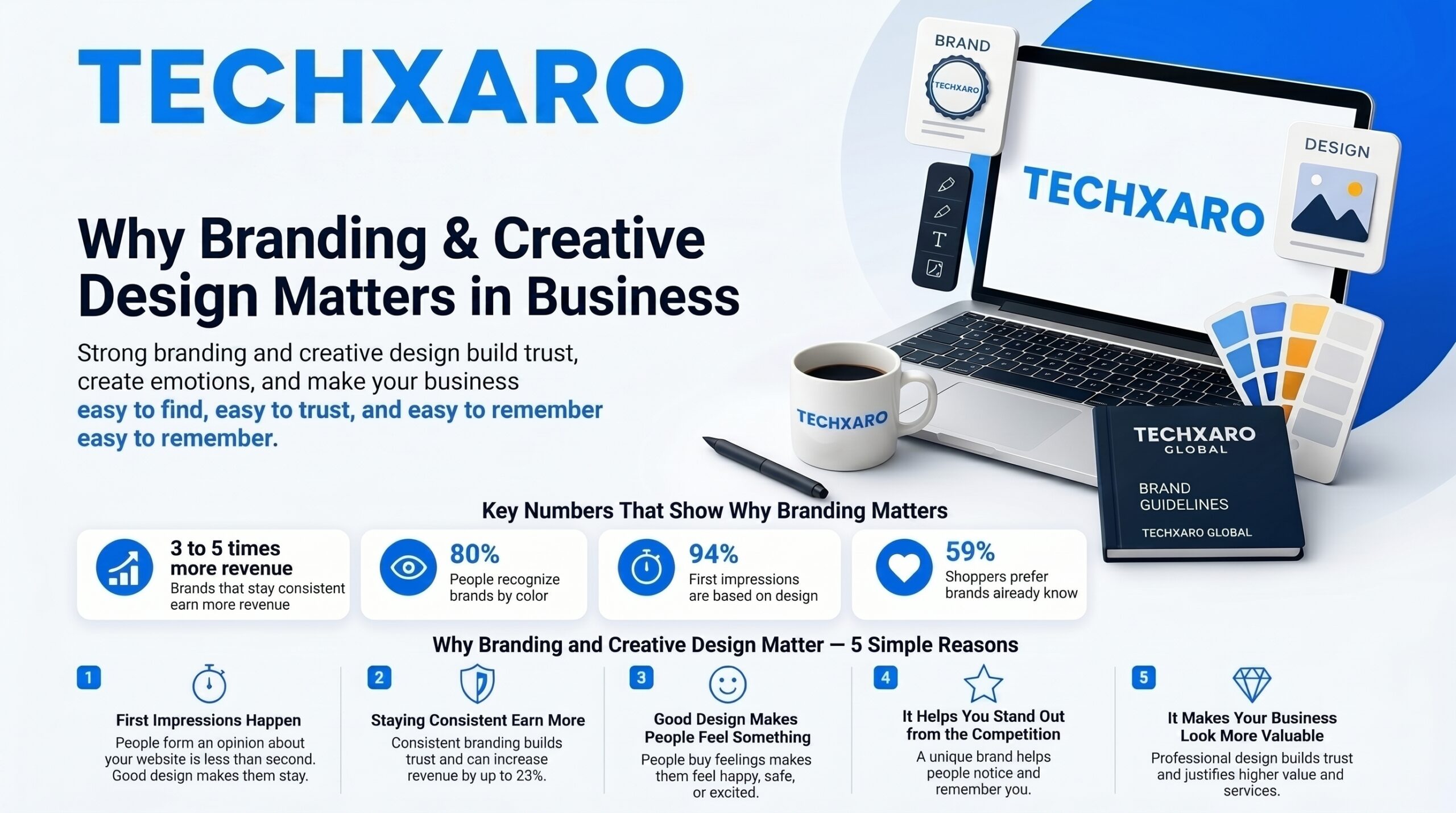
    Key Numbers That Show Why Branding Matters

    The facts below show how powerful good branding and design can be for any business around the world.

    Fact Number
    Brands that stay consistent earn more revenue 3 to 5 times more
    People who recognize brands by color 80%
    First impressions that are based on design 94%
    Shoppers who prefer brands they already know 59%

    Why Branding and Creative Design Matter 5 Simple Reasons

    1. First Impressions Happen in Seconds

    Research shows that people form an opinion about your website in less than one second. If your design looks old or messy, people will leave right away. A clean and professional design makes people want to stay and learn more about you.

    Businesses with strong visual presentation often improve conversions by combining branding with SEO and digital marketing strategies that increase targeted traffic.

    2. Staying Consistent Helps You Earn More

    When your brand looks the same on your website, your emails, and your social media, people feel they can trust you. Businesses that keep their branding the same everywhere can earn up to 23% more revenue. It is a small habit that makes a big difference.

    Consistent visuals also improve performance across SEO and digital marketing campaigns by making your business more recognizable online.

    3. Good Design Makes People Feel Something

    People do not just buy products. They buy feelings. The right colors, images, and design style make your audience feel happy, safe, or excited. When your brand creates a good feeling, people keep coming back and they tell their friends about you too.

    Many companies improve emotional connection through strong user centered design experiences across websites and mobile applications.

    4. It Helps You Stand Out from the Competition

    There are many businesses online that look exactly the same. A strong and unique brand identity makes people notice you and remember you. When someone can spot your brand quickly, they are much more likely to choose you over someone they do not recognize.

    A professionally designed website combined with modern website development can help create a more memorable customer experience.

    5. It Makes Your Business Look More Valuable

    When a business looks polished and professional, people naturally trust it more. Good creative design also makes people feel like they are getting something premium which means they are often willing to pay more for your product or service.

    Businesses that invest in strong visual branding often pair it with SEO and digital marketing to increase visibility and perceived authority.

    🎨 Stop Blending In. Build a Distinguishable Market Authority. From comprehensive brand style guides and custom iconographies to conversion focused UI UX assets, TechXaro bridges the gap between high level creative artistry and measurable business metrics. 👉 Claim Your Free Brand Positioning & Design Strategy Session

    Branding vs. Creative Design What Is the Difference?

    Area Branding Creative Design
    What it is Your identity and message How that identity looks
    What it includes Values, voice, mission Logo, colors, fonts, website
    Main goal Build trust and recognition Attract and communicate visually
    How long it lasts Long term asset Updated regularly
    How you measure it Customer loyalty and reputation Clicks, traffic, and sales
    Who handles it Leadership and marketing team Design and product team

    How to Build a Strong Brand with Creative Design

    Step 1: Get Clear on Who You Are

    Before you design anything, answer these simple questions. What problem do you solve? Who are your customers? What do you want people to say about your business? These answers will guide every design decision you make.

    Step 2: Build Your Visual Identity

    Your visual identity is more than just a logo. It includes your brand colors, your fonts, the style of your images, and the way everything looks together. Write all of this down in a simple brand guide so your whole team follows the same rules.

    Companies building scalable online brands often combine visual identity with ecommerce solutions that create a seamless customer experience.

    Step 3: Use It the Same Way Everywhere

    From your website to your emails to your social media posts everything should look and feel like it belongs to the same brand. The more consistent you are, the faster people will recognize and remember you.

    Step 4: Update It Every Few Years

    You do not need to change your brand every year. But a small visual refresh every 5 to 7 years keeps your brand looking modern. The key is to stay fresh without losing the recognition you have already built.

    Businesses planning a modern refresh can review this complete digital transformation strategy guide to align branding with long term growth.

    At Techxaro, we help software companies around the world turn their vision into a brand identity and creative design system that works and grows with their business.

    🚀 Stop Settling for Outdated Visuals. Own Your Space.

    Ready to transform how the market perceives your business? Schedule a direct visual evaluation session with TechXaro’s lead designers today. We’ll isolate your brand’s style gaps and construct an execution framework engineered to convert.

    👉 Book Your Free Creative Branding Consultation

    Frequently Asked Questions

    What is the difference between branding and marketing?

    Branding is who you are. Marketing is how you tell people about it. Your brand stays the same for a long time. Your marketing changes depending on what you want to promote. You need a strong brand first before your marketing can work properly.

    How much should a business spend on creative design?

    Most growing businesses spend between 5 and 15 percent of their yearly revenue on branding and design. Even starting small with a good logo, a clean website, and a simple brand guide can make a big difference in how people see your business.

    Can small businesses benefit from branding?

    Absolutely. In fact, a clear and consistent brand helps small businesses look just as professional as big companies. It builds trust quickly and helps you win customers even if your budget is small.

    How does creative design affect customer trust?

    When your design looks clean and professional, people trust you right away. When it looks messy or outdated, people assume your product is also low quality even if it is not. Design is usually the first thing a customer judges.

    How often should a business refresh its brand design?

    A small visual update every 5 to 7 years is usually enough to keep your brand looking fresh. A full rebrand is only needed if your business changes direction completely or goes through something major like a merger.

    What are the key parts of a good creative design system?

    The most important parts are your color palette, your fonts, your logo with usage rules, your image style, and a simple brand guide that explains how to use all of these together. Once you have this, your whole team can keep everything looking consistent every day.

    Final Thoughts

    Branding and creative design are not just about looking good. They are about making people feel confident enough to choose you. A clear brand and a good design make your business easy to find, easy to trust, and easy to remember. Whether you are just starting out or already growing globally, the businesses that invest in how they look and feel are the ones that grow faster and last longer.

    If you want to strengthen your online visibility even further, explore our search engine optimization strategies to support long term business growth.


    Claim Your Free Brand Identity & Creative Audit Today

Let Us Contact You!

Free Consultation

Need Expert Services?

We deliver reliable, high-quality solutions tailored to your business needs, on time and on budget.

Or reach us directly
Free Consultation

Need Expert Services?

We deliver reliable, high-quality solutions tailored to your business needs, on time and on budget.

Or reach us directly